KEY INSIGHTS
- Around half of frontline workers live pay cheque to pay cheque: 55% in Australia and 51% in New Zealand
- 76% of Australian and 76% of New Zealand frontline employees work voluntary overtime at least occasionally.
- 65% of Australian and 58% of New Zealand frontline employees feel they are “living to work” rather than “working to live.
Most organisations have responded to burnout by adding something. A wellness program, a mindfulness app, an EAP number, a fruit bowl in the break room. The things causing the burnout stay exactly where they were. And the scale is bigger than most executive teams register.
Frontline employees, all the people who have to physically show up to care for patients, stock shelves, staff production lines and serve customers, make up an estimated 70 to 80 per cent of the global workforce, and millions of New Zealanders work this way.
Eighty per cent of NZ frontline workers told UKG’s latest ANZ frontline study they feel burned out, and that is a workload and leadership problem dressed up as a wellness problem, because the wellness version is cheaper to fix on paper.
The frontline carries a strain that is largely invisible to the people in head office making decisions about their roster, and no amount of free fruit is going to fix a structural problem. (The fruit is fine, we love the fruit, it’s just not a strategy.)
Two cultures, one employer
UKG’s global frontline study reports that about half of global frontline workers feel there are two separate cultures in their organisation, one for the frontline and one for everyone else. That tension is visible in how burnout affects their day‑to‑day experience.
In UKG’s ANZ frontline study, 80% of Australian frontline workers and 70% of New Zealand frontline workers report feeling burned out. When they are burnt out, 86% of Australian and 85% of New Zealand frontline employees say they are less productive, and 76% of Australian and 80% of New Zealand frontline workers say they make more mistakes.
More than half say they cannot take as much time off as they’d like, and almost half believe their work schedule makes it impossible to maintain a healthy lifestyle. A majority are also caregivers (57% in Australia and 54% in New Zealand) and over 80% of those caregivers say it is hard to manage both their workload and their caregiving responsibilities, with significantly higher burnout than non‑caregivers.
Those numbers are exactly what a two‑tier culture feels like in practice: frontline workers keeping everything running while feeling overworked, under‑recognised and excluded from the version of “flexibility” and “wellbeing” experienced in the office.
ALSO READ: The 5 Elements Of Meaningful Work In The AI Era
Burnout is a profit and loss problem, it just might not have made it into the right spreadsheet yet. When 86 per cent of burned out Australian frontline workers say they are less productive and 76 per cent say they make more mistakes, those are quality failures and safety risks. The organisations that take frontline wellbeing seriously have worked out that the alternative is far more expensive. They are just yet to attribute it to the right line item.
Two pay errors and your best frontline workers start job hunting
After just two errors in their pay cheque, 39 per cent of ANZ frontline workers would start looking for a new job. That is a rational response to an employer who cannot be trusted to get the most basic thing right. Two wrong pay cheques tell an employee the systems are inadequate, or that they are simply not a priority, and once that belief takes hold it is very hard to shift. People leave when the small things that were supposed to be reliable keep letting them down.
Money belongs in the same conversation. More than half of the ANZ frontline (53 per cent) cannot afford to save for retirement, and 57 per cent are also managing caregiving responsibilities at home. That pressure clocks on with them. It shows up as absenteeism and, eventually, the quiet decision to start looking elsewhere. Retaining the frontline means thinking beyond base pay: pay that is right the first time, superannuation done properly, access to earned wages when needed, and honest conversations about financial security. Bury those in the intranet and they do not count.
Letting people build their own roster
Seventy-six per cent of ANZ frontline workers do voluntary overtime at least occasionally. They want the hours, with some say in when the hours happen. Give them real self-scheduling: nominating preferred availability, swapping shifts through simple technology, picking up extra hours when it suits, and seeing the roster far enough ahead to plan a life.
These are basic acts of respect with a measurable impact on retention, and 78 per cent of the ANZ frontline already say technology has made their schedule easier to manage. The tools exist. The organisations using them properly are already seeing the benefit.
 Source: Rethinking AI ROI, Great Place To Work and UKG
AI and the Frontline: Treat your people like adults
On AI, 54 per cent of ANZ frontline workers say their employer is preparing them for an AI-driven workplace, which leaves nearly half figuring it out on their own. That adds up to a hope, and hope is a poor rollout plan.
The frontline is already anxious about job security and financially stretched. Drop an AI rollout into that environment without an honest conversation about why you are doing it and what it means for their role, and it will feel like the beginning of being replaced. That fear is completely valid.
So talk to your frontline before you announce anything. Ask where the friction in their work is and where they waste time on things that feel pointless, then show them how AI addresses specifically those things. Be incredibly specific: here is the thing AI is going to do, here is how it makes your working day easier, here is what is not changing, and here is how we will support you through it. Vague AI enthusiasm from leadership creates a vacuum, and people fill vacuums with their worst fears.
The appetite for technology on the frontline is a gift. People leaders who use it well will bring their teams through the AI transition. The ones who just announce a rollout will find out the hard way why 36 per cent of Australian frontline workers said they would quit if AI is forced on them in ways that do not make sense.
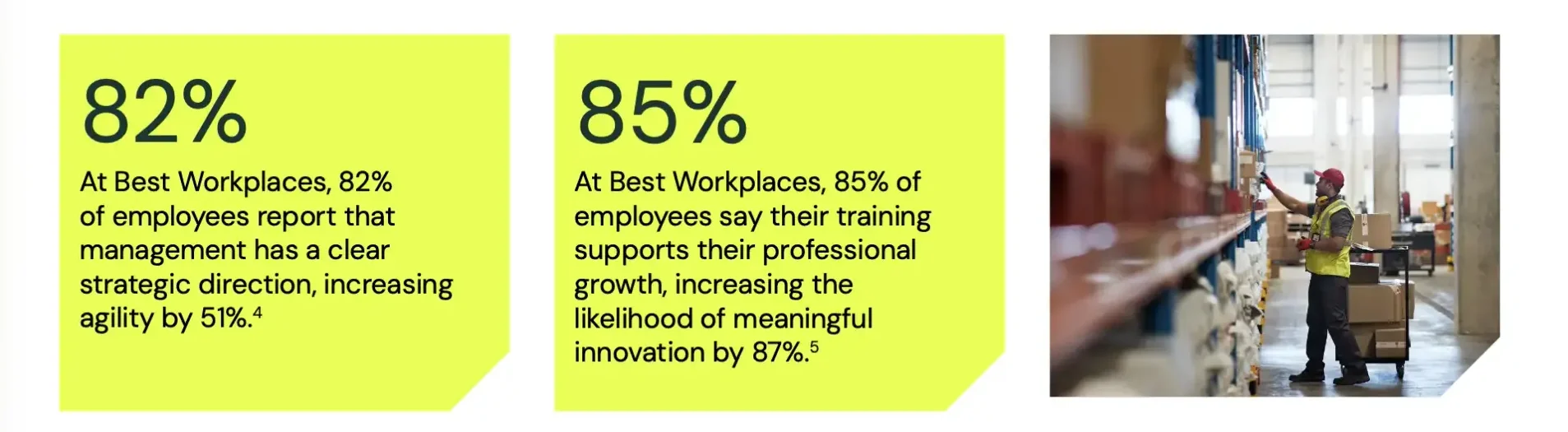
The Best Workplaces are already showing what this looks like in practice. They position AI as a tool that supports decision making, with people staying responsible for the outcomes that affect customers and colleagues. Their leaders are transparent about where AI is and is not being used, and about how decisions get made. And they build systems that let employees engage with AI directly: peer ambassador programs, workshops, open forums and office hours, and real channels for employees to share feedback and ideas. The numbers reward them for it.
At the Best Workplaces, employees who are involved in decisions are 41 per cent more likely to adapt quickly to change, and workplaces that emphasise peer collaboration see discretionary effort increase by 43 per cent. That is the whole argument of this piece in two statistics.
Get the roster right, get the pay run right, make the role liveable, and bring the frontline into the conversation before the announcement, because the organisations that treat their frontline as participants in the future of work will be the ones that still have a frontline to build it with.
DOWNLOAD THE FULL REPORT More Perspectives from the Frontline Workforce: ANZ edition