


KEY INSIGHTS
- The best workplace culture benchmarks compare your data to trusted external standards.
- Candidates pay most attention to recognised workplace awards and independent benchmarks.
- High-performing organisations benchmark culture by combining anonymous employee surveys, external indices, and outcome metrics.
Even a casual analyses of engagement programs show that many organisations report benchmarked scores that sit at or above industry averages, while their HR practitioners say engagement has stayed flat or declined.
One study found 63 percent of HR practitioners reported stagnant or falling engagement despite widespread benchmarking. This gap suggests that benchmarks can reassure leaders without fixing underlying culture issues.
Engagement surveys and benchmarks often measure sentiment rather than the conditions that drive performance and retention, which limits their usefulness for change. In other words, the number can look good long before the experience at work does.
That is why the hardest part of benchmarking is not the maths but the judgment about what to compare against and how much weight to give those comparisons.
How do leading organisations benchmark workplace culture?
Leading organisations benchmark culture in layers instead of fixating on a single external number. They combine:
- Internal trend benchmarks: Comparing this year’s results to previous cycles, by business unit and demographic group, to see where experiences are improving or stalling.
- External reference points: Using national, industry, or regional benchmarks built from large datasets to understand where they sit in the wider market.
- Best-in-class comparisons: Looking at top-quartile or “best workplaces” benchmarks to set stretch aspirations rather than settling for average.
They use employee surveys that focus on conditions such as trust, fairness, growth, and support from managers, and they connect those results to outcomes like attrition, safety, productivity, and promotion rates.
ALSO READ: Is Your Employee Engagement Survey Asking the Wrong Questions?
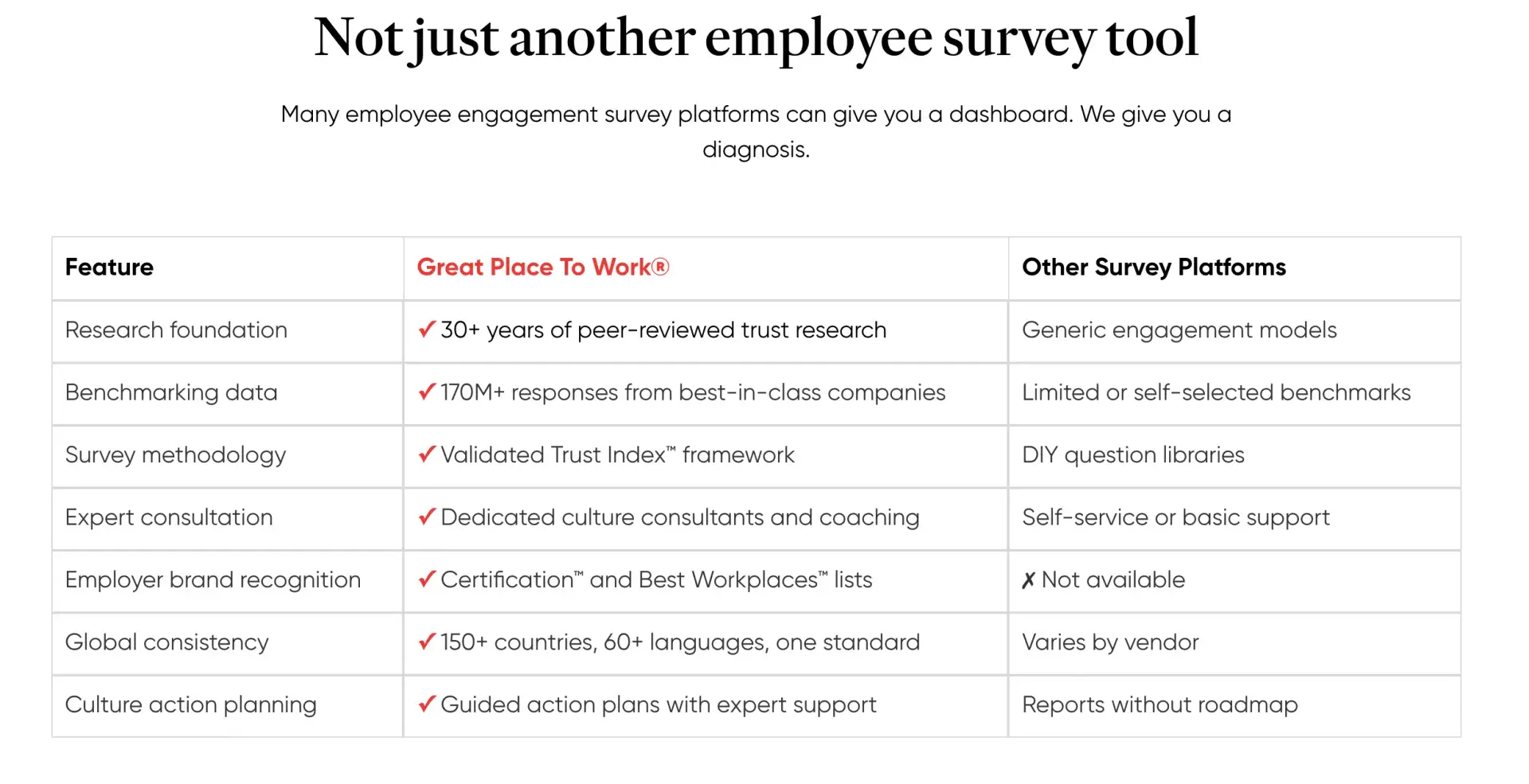
Great Place To Work’s Trust Index sits in this space: it asks employees confidentially about trust in leaders, pride in their work, and camaraderie with colleagues, then benchmarks those results by size, sector, and region so organisations can read their scores in context.
Why are workplace culture benchmarks so tricky to choose?
Choosing benchmarks is tricky because culture is context-specific while benchmarks are, by design, general. Several common pitfalls show up across research and practitioner commentary:
Generic benchmarks that do not fit your workforce. Using broad (all industries) benchmarks can mislead if your workforce skews younger, more frontline, or more distributed than the norm.
Old or shallow datasets. Some benchmarks rely on small or outdated samples, which reduces their relevance to current labour market conditions.
Over-valuing the average. Being a little above an average that is itself low can encourage complacency instead of improvement.
Ignoring representation issues. If response rates are strong in some groups and weak in others, benchmarked scores may not reflect the people whose experiences you most need to understand.
Evidence reviews also warn that if leaders treat engagement or culture scores as precise indicators of performance, they may make confident decisions on the basis of measures that do not strongly predict outcomes. That is why credible benchmarks must be paired with internal analysis and a clear view of what good looks like in your own context.
How should organisations choose the right workplace culture benchmarks?
Research and practitioner guidance point to several criteria for selecting culture benchmarks.
Relevance: Benchmarks should align with your sector, geography, size band, and workforce mix (for example, proportion of frontline versus office-based employees).
Robustness: Strong benchmarks draw on large, diverse datasets and are refreshed regularly so they reflect current conditions rather than pre-pandemic patterns.
Transparency: The provider should explain how questions are constructed, how favourability is calculated, and how comparison groups are defined.
Actionability: Benchmarks should be granular enough to support decisions (for example, by topic and population), not just present a single composite index that is hard to act on.
Organisations using the Trust Index, for example, can benchmark scores across dimensions such as credibility, respect, fairness, pride, and camaraderie, and compare them with peers in similar industries or regions. This lets leaders choose the comparisons that matter most for their strategy instead of relying on a single global average.
What goes wrong when organisations obsess over benchmarks?
Multiple sources highlight that an over-attachment to benchmarks can slow real progress. Typical failure modes include:
Benchmark-chasing over problem-solving: Leadership conversations centre on staying above a line rather than understanding the experiences behind the scores.
Data used as public relations: Teams experiment with counting neutral responses as positive or excluding struggling units to protect headline numbers, which undermines trust in the process.
Generic questions for the sake of comparability: Surveys are kept broad so they map neatly onto external benchmarks, at the cost of asking the specific questions that would reveal local issues.
Researchers also note that when survey results are not communicated clearly and follow-up action is inconsistent, employees become sceptical and less likely to respond honestly in future cycles. In that environment, even good benchmarks will not reflect reality because the listening system itself has lost credibility.
How do leading organisations balance external benchmarks with internal progress?
The organisations that seem to get the most from benchmarks keep external comparisons in their place. They typically:
Use external benchmarks as a context setter rather than the main KPI, for example to explain to boards and executives whether scores are broadly in line with peers.
Focus day-to-day on internal benchmarks and bright spots, comparing teams or cohorts within the organisation to learn what conditions support better outcomes.
Track a small number of leading indicators linked to outcomes (for example, perceptions of fairness and growth opportunities linked to retention) and watch how those move over time relative to both internal and external reference points.
Great Place To Work’s Trust Index supports this balance by providing both global and local benchmarks as well as internal comparisons across teams and demographics, so leaders can see where they outperform peers and where they need to raise their own standard. The benchmark becomes a compass, not a scoreboard.
FAQs Workplace Culture Benchmarks
How do leading organisations benchmark workplace culture without getting stuck?
Leading organisations treat benchmarks as one input among several. They compare survey scores to internal trends, similar organisations, and best-in-class examples, but they keep the focus on understanding what their own people say needs to change. They also check that benchmarks are current, representative, and transparent, and they prioritise action on the issues those benchmarks highlight.
What makes choosing workplace culture benchmarks so difficult?
Choosing workplace culture benchmarks is difficult because most datasets are built from broad averages that may not match your workforce or strategy. Benchmarks can also create a false sense of security if scores look “above average” while engagement, retention, or performance stagnate. The challenge is to find benchmarks that are relevant, up to date, and paired with internal analysis, rather than relying on generic comparisons.
How should an HR team pick the right workplace culture benchmarks?
An HR team should start by clarifying which talent markets, regions, and workforce segments matter most, then select benchmarks that match those characteristics. They should favour providers that explain their methods, use large and recent datasets, and allow segmentation by topic and population. It also helps to combine external benchmarks with internal trends and team-level comparisons, so decisions are grounded in both context and the organisation’s own progress.


